


You've seen them on runways, red carpets, and probably in your own jewelry box, but what are hoop earrings, exactly? At their simplest, they're circular or semicircular earrings that loop from the front of the earlobe to the back. But that basic definition barely scratches the surface. Hoops come in dozens of shapes, sizes, and materials, and their history stretches back thousands of years to some of the earliest civilizations on earth.
Whether you're drawn to thin, understated rings or chunky, statement-making loops, there's a hoop style for every face shape, outfit, and occasion. That versatility is exactly why we carry so many hoop variations at Ezra Gems, from classic gold-plated rounds to bold, modern silhouettes built to handle everyday wear without tarnishing or turning your ears green.
This guide covers everything you need to know: the origins of hoop earrings, the most popular styles and sizes available today, how to pick the right pair for your look, and practical tips for keeping them in great shape. By the end, you'll have a clear picture of why hoops have remained one of the most versatile accessories in jewelry, and how to wear them with confidence.
Why hoop earrings stay popular
Hoops have been around for thousands of years, yet they never feel outdated. That staying power comes from a combination of factors: a simple shape that flatters almost every face, a wide range of sizes and materials, and a cultural presence that spans continents and generations. When you look closely at what are hoop earrings and why people have worn them from ancient Egypt through to today, their continued popularity stops being surprising and starts making obvious sense.
Deep historical roots
Hoops are among the oldest jewelry forms ever discovered. Archaeological finds place them in Sumerian culture around 2500 BCE, and they appear throughout ancient Egyptian, Greek, Roman, and Nubian histories. That's not a coincidence. A circular form that threads through the earlobe is one of the most intuitive and structurally stable designs a jeweler can make, which is why cultures that had no contact with each other independently arrived at the same shape over and over again.

The fact that hoop earrings appeared across so many unconnected ancient civilizations tells you something important: the design works, and it has always worked.
This deep historical grounding gives hoops a credibility that trend-driven styles often lack. When you wear a pair of gold-plated hoops, you're wearing something that connects you to centuries of human expression, not just a passing seasonal trend. That sense of permanence is part of what keeps people reaching for them.
They adapt to every personal style
One of the strongest reasons hoops keep showing up in jewelry boxes across generations is their flexibility. A thin 14mm gold hoop works as a subtle, everyday piece you barely notice you're wearing. A 60mm textured hoop becomes a statement accessory that shapes an entire outfit on its own. That range means you can use hoops as a quiet background detail or a bold focal point, depending on what you need from your look that day.
Your personal aesthetic also doesn't need to fit any particular category for hoops to work. Minimalist, maximalist, casual, and formal wardrobes all have a version of the hoop earring that slots in naturally. Very few jewelry categories can make that claim, which is why hoops hold their ground even as other earring styles cycle in and out of fashion.
Beyond personal style, hoops also pair well with other jewelry. You can stack them in multiple piercings, combine them with stud earrings in adjacent holes, or wear them alone as your only accessory. That layering ability makes them a practical choice for anyone building a flexible jewelry collection.
Cultural moments keep bringing them back
Hoops carry strong cultural significance across multiple communities, particularly in Black and Latina cultures in the United States, where large hoop earrings have long been markers of identity, pride, and heritage. That cultural weight means hoops are never far from the mainstream conversation, even during periods when jewelry trends shift toward other silhouettes. The meaning behind the style gives it staying power that goes beyond aesthetics alone.
Beyond cultural identity, hoops consistently appear on red carpets, in editorial shoots, and across social platforms, which keeps them visible and relevant to entirely new audiences. Each generation discovers the hoop for slightly different reasons, whether it's the historical connection, the practicality, or the sheer range of options available. They all tend to arrive at the same conclusion: hoops are a versatile, flattering piece that earns a permanent spot in any jewelry collection, regardless of what else is trending at the moment.
What counts as a hoop earring
When people ask what are hoop earrings, the answer seems obvious at first: it's a circular earring. But the category is broader than a single shape. The defining trait of a hoop is that it forms a loop that passes through the ear, connecting at two points on the earlobe rather than sitting flat against the front of it the way a stud does. That through-the-ear structure is what separates hoops from drop earrings, dangles, and climbers, even when those styles share a similar visual weight or silhouette.
The core defining features
A true hoop has two non-negotiable characteristics: a continuous or near-continuous loop and a closure system that anchors the earring at the back of the lobe. The loop can be perfectly circular, oval, square, or geometric, and it still qualifies as a hoop as long as it wraps around the ear rather than simply hanging from it. That distinction matters when you're shopping, because it tells you something about how the piece will actually sit and move on your ear.
The shape of the loop matters less than the structure: if it wraps through your ear, it's a hoop.
Most hoops range from ultra-thin wire rings to thick tubular bands, and the loop itself can be solid metal, hollow tubing, or even a fabric or resin-covered frame. The material and thickness affect overall weight, which in turn affects how the earring hangs and how comfortable it feels over a full day of wear.
Where the definition gets flexible
Some styles sit right at the edge of the category. Huggie earrings, for example, have a very small diameter that hugs the lobe closely, making them look almost like thick studs from the front. They still use the same through-the-ear loop structure, so most jewelers classify them as hoops. Open-hoop or C-hoop styles don't close at the back at all; the wire ends before completing the full circle, leaving a visible gap. These count as hoops too, because the loop still passes through the piercing.
Geometric hoops, teardrop hoops, and square hoops also fall under the hoop umbrella. What keeps them all in the same family is that structural loop mechanic, not the specific shape of the metal itself.
Hoop earring sizes and how to measure them
Size is one of the most practical things to understand when figuring out what are hoop earrings and how to shop for them confidently. Hoop size is measured by diameter, which is the straight-line distance across the inside of the loop from one edge to the other. Most listings use millimeters, though some brands list diameter in inches. Knowing your preferred size in millimeters makes it much easier to shop consistently, especially online where you can't physically hold the earring before buying.
How the diameter scale breaks down
The size range for hoops is wider than most people expect. Small hoops start around 10mm to 20mm, which keeps them close to the lobe and works well for a subtle, everyday look. Medium hoops run from roughly 25mm to 40mm, giving you visible movement and shape without overwhelming your face. Large hoops start at 45mm and can extend well past 60mm, making them an intentional statement piece that shapes your entire look from the shoulders up.
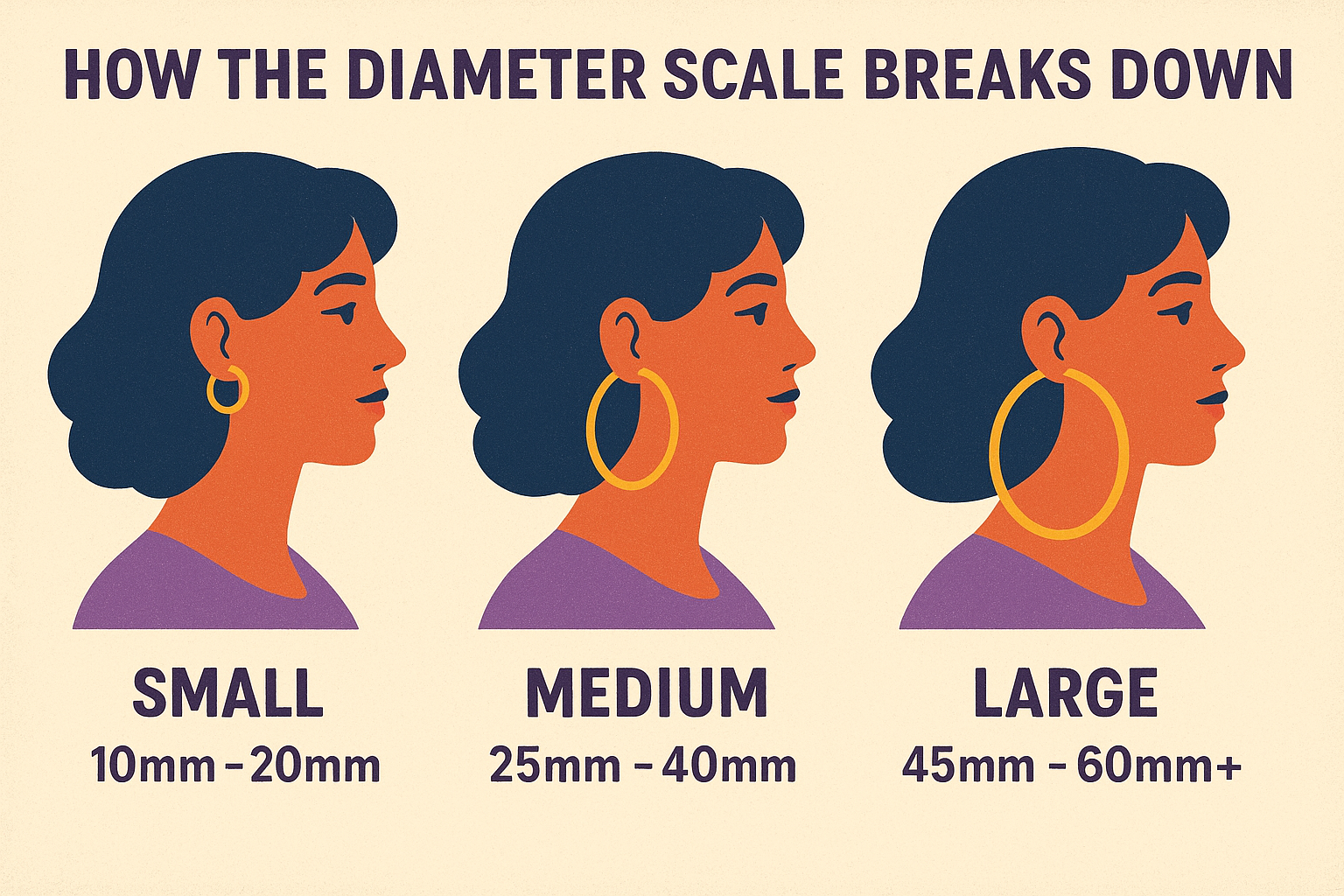
A 20mm hoop and a 50mm hoop can both be described as "gold hoops," but they create completely different visual effects, so always check the listed diameter before you buy.
| Size Range | Diameter | Best For |
|---|---|---|
| Small | 10mm - 20mm | Everyday wear, multiple piercings |
| Medium | 25mm - 40mm | Versatile, most face shapes |
| Large | 45mm - 60mm+ | Statement looks, special occasions |
How to measure for the right fit
You don't need special tools to figure out which size works for your ear. Hold a ruler next to your earlobe and estimate how far below the lobe you want the bottom of the hoop to fall. That distance, plus the radius of the hoop (half the diameter), gives you a rough guide for the size you need. For example, if you want the hoop to sit about 15mm below your lobe, a 30mm to 35mm diameter hoop will give you that drop.
Your lobe thickness also affects fit slightly, since thicker lobes take up a small amount of the interior space. Most standard hoop sizing accounts for average lobe thickness, but if your lobes are particularly thick or your piercings sit higher, size up slightly to keep the proportions looking balanced.
Hoop styles you will see most often
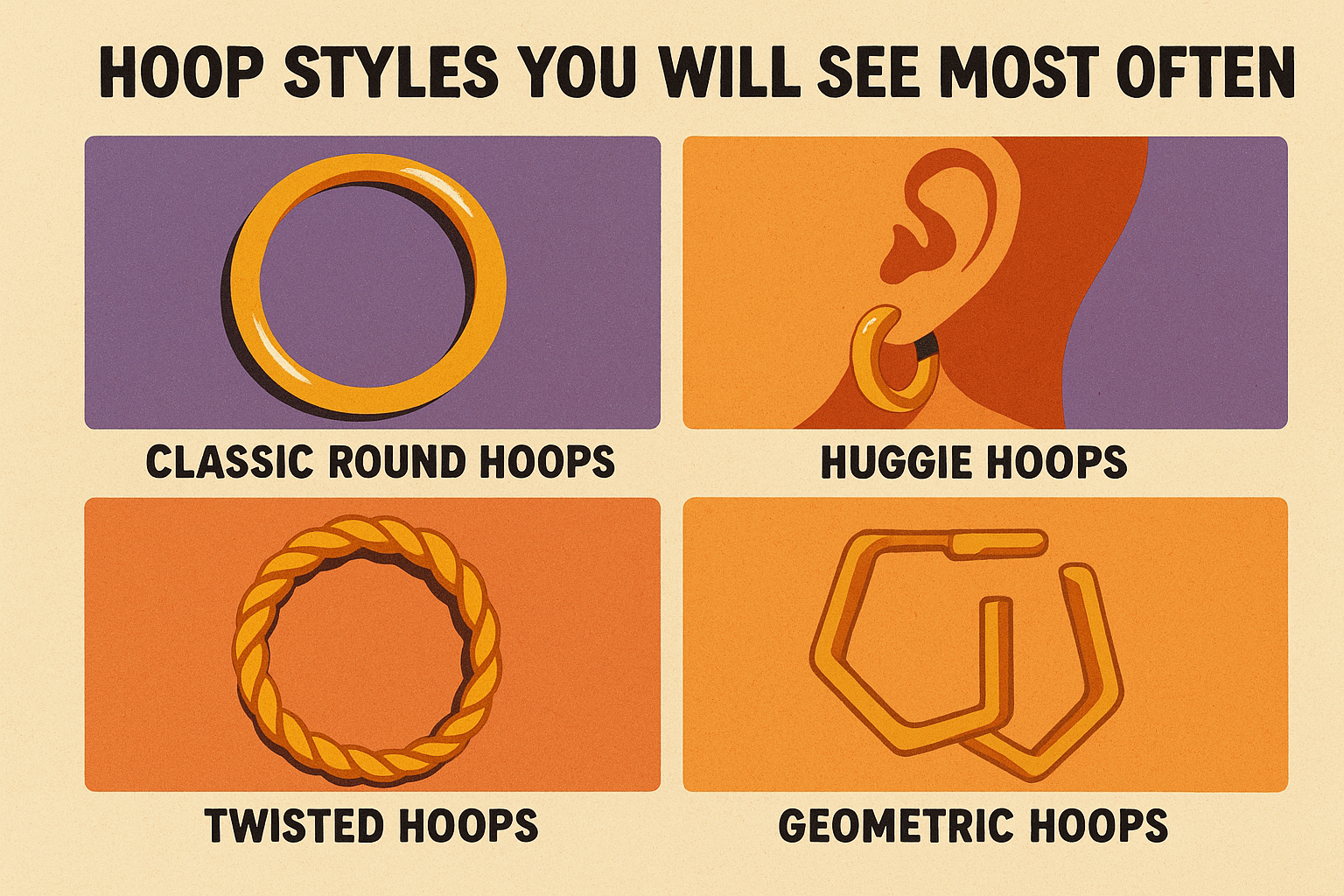
Understanding what are hoop earrings goes beyond knowing the basic structure. The category breaks into several distinct styles, each with its own look and practical purpose. Knowing the difference between them helps you shop with intention and build a collection that actually covers the occasions you dress for.
Classic round hoops
The classic round hoop is the style most people picture first: a smooth, continuous circle of metal that comes in a range of thicknesses and diameters. Thin wire versions read as delicate and minimal, while wider tube-style rounds carry more visual presence. This style works in virtually any metal finish, from polished gold to brushed silver, making it the most adaptable option in the entire hoop category.
Classic round hoops are the foundation of any jewelry collection because they pair with almost every outfit without competing for attention.
If you only own one style of hoop, this is the one to start with. You can wear them with a structured blazer, a simple T-shirt, or a formal dress and they hold their own in all three contexts without adjustment.
Huggie hoops
Huggie hoops use the same through-the-ear loop structure as standard hoops, but their diameter is small enough that the earring sits flush against the lobe rather than hanging below it. The result is a piece that looks almost like a thick stud from a distance. Huggies work especially well in second or third piercings alongside larger statement hoops in the first hole, giving your ear a layered look without crowding.
Many huggie styles include small embellishments like pavé stones or twisted wire along the outer edge, which adds detail without adding weight. That combination of compact size and design variation makes them a strong everyday option for people who want something more polished than a plain stud.
Twisted and geometric hoops
Twisted hoops feature a spiral or rope-like surface along the metal, which catches light differently than a smooth finish and adds texture without requiring extra stones or engraving. Geometric hoops take a different route, replacing the circle with square, rectangular, or angular frames that give the earring a more modern, architectural feel.
Both styles work best when the rest of your jewelry stays minimal, since the shape itself does the heavy lifting. Pair either option with a clean neckline to let the earring read clearly and create a finished, deliberate look.
Hoop closures and how they work
One practical detail that often gets overlooked when people ask what are hoop earrings is how the earring actually stays in your ear. The closure is the mechanism that connects the two ends of the loop, and different closure types affect how easy the earring is to put on, how secure it feels during wear, and how long the piece lasts with regular use. Understanding the main closure styles helps you pick hoops you'll actually enjoy wearing day to day.
Hinged and snap closures
Hinged closures are the most common system you'll find on medium and large hoops. A small hinge connects the two halves of the loop, and one end snaps into a notch or groove on the other side to lock the earring in place. When you want to put the earring on, you open the hinge, thread the post or thin end through your piercing, and snap it closed from behind your lobe.
A well-made snap closure should click firmly into place with no wobbling, which tells you the earring will stay secure through a full day of activity.
This system works well for hoops from about 25mm upward because the weight of the loop benefits from a firm locking point. Look for closures that snap with a satisfying click rather than ones that feel loose right out of the packaging, since a weak snap tends to get worse over time with repeated opening and closing.
Continuous or seamless hoops
Seamless hoops have no visible hinge or clasp at all. Instead, the metal forms a single continuous ring with one small gap where the two ends meet. You rotate the ring slightly to separate the ends, thread it through your piercing, and rotate it back until the ends line up flush. The result is a clean, unbroken circle with no hardware showing, which makes this closure the go-to choice for thin wire hoops and sleeper-style earrings meant for extended wear.
Threader and lever-back styles
Threader hoops use a thin, flexible wire that you guide directly through your piercing from front to back, with the decorative loop hanging at the front. Lever-back closures attach a hinged lever at the back of the earring that clicks up over a fixed post, adding extra security without requiring you to fumble with a traditional snap. Both options are worth considering if you prefer a closure that feels locked in place rather than one that relies on friction alone.
Materials, plating, and skin sensitivity
The material your hoops are made from affects how they look, how long they last, and how your skin reacts to wearing them. When people research what are hoop earrings and how to wear them comfortably, they often skip the material conversation entirely, which leads to irritation, discoloration, or disappointment. Understanding the basics of metal composition and plating helps you pick hoops you can actually wear without issue.
Common base metals and their effects
Brass, copper, and zinc alloys are the most common base metals used in fashion jewelry because they're affordable, easy to shape, and hold plating well. The downside is that these metals can react with moisture and cause skin discoloration or irritation in people sensitive to nickel, which manufacturers frequently add to alloys to improve durability. Sterling silver contains 92.5% silver and is a cleaner base option, though it still tarnishes over time without regular care.
If your ears turn green or feel itchy after a few hours of wear, the base metal is almost always the cause, not the plating itself.
| Base Metal | Skin-Friendly? | Tarnish Risk |
|---|---|---|
| Brass/Copper alloy | Low (may irritate) | High |
| Sterling silver | Moderate | Moderate |
| Surgical steel | High | Low |
| Titanium | Very high | Very low |
Gold plating and what the numbers mean
Gold-plated jewelry uses a thin layer of real gold applied over a base metal, which gives you the look and warm tone of solid gold at a fraction of the cost. The thickness of that gold layer is measured in microns, and thicker plating lasts significantly longer before the base metal shows through. Look for pieces described as "gold vermeil" or "thick gold-plated" for better wear life compared to standard flash-plated options.
At Ezra Gems, the gold-plated hoops are designed for daily wear, meaning the plating resists the tarnishing and fading that thinner alternatives show after just a few weeks of regular use, including through showering and sweating.
Managing skin sensitivity
Nickel sensitivity is one of the most common contact allergies in the United States, affecting roughly 10 to 20 percent of the population. If you know you react to certain metals, prioritize hoops made with surgical-grade steel, titanium, or verified nickel-free plating as your starting point.
A few practical steps can also reduce irritation:
- Keep your earrings dry between wears and store them in a pouch to slow oxidation
- Remove hoops before swimming in chlorinated pools or saltwater
- Clean your piercings with saline solution if redness develops after new earrings
How to choose hoops for your face and lifestyle
Understanding what are hoop earrings and which pair works for you comes down to two things: your face shape and how you actually live day to day. A hoop that looks stunning in a product photo might feel out of proportion on your face or impractical for your routine. Taking both factors into account before you buy saves you from earrings that sit unworn in a drawer after the first try.
Matching hoop size to your face shape
Round and square faces benefit from larger, elongated hoops because the extra length below the jaw creates a vertical line that balances wider facial proportions. Oval faces are the most flexible, handling everything from small huggies to oversized statement hoops without losing visual harmony. Narrow or heart-shaped faces tend to suit small to medium hoops in the 20mm to 35mm range, since very large hoops can make the upper half of the face appear even wider by comparison.
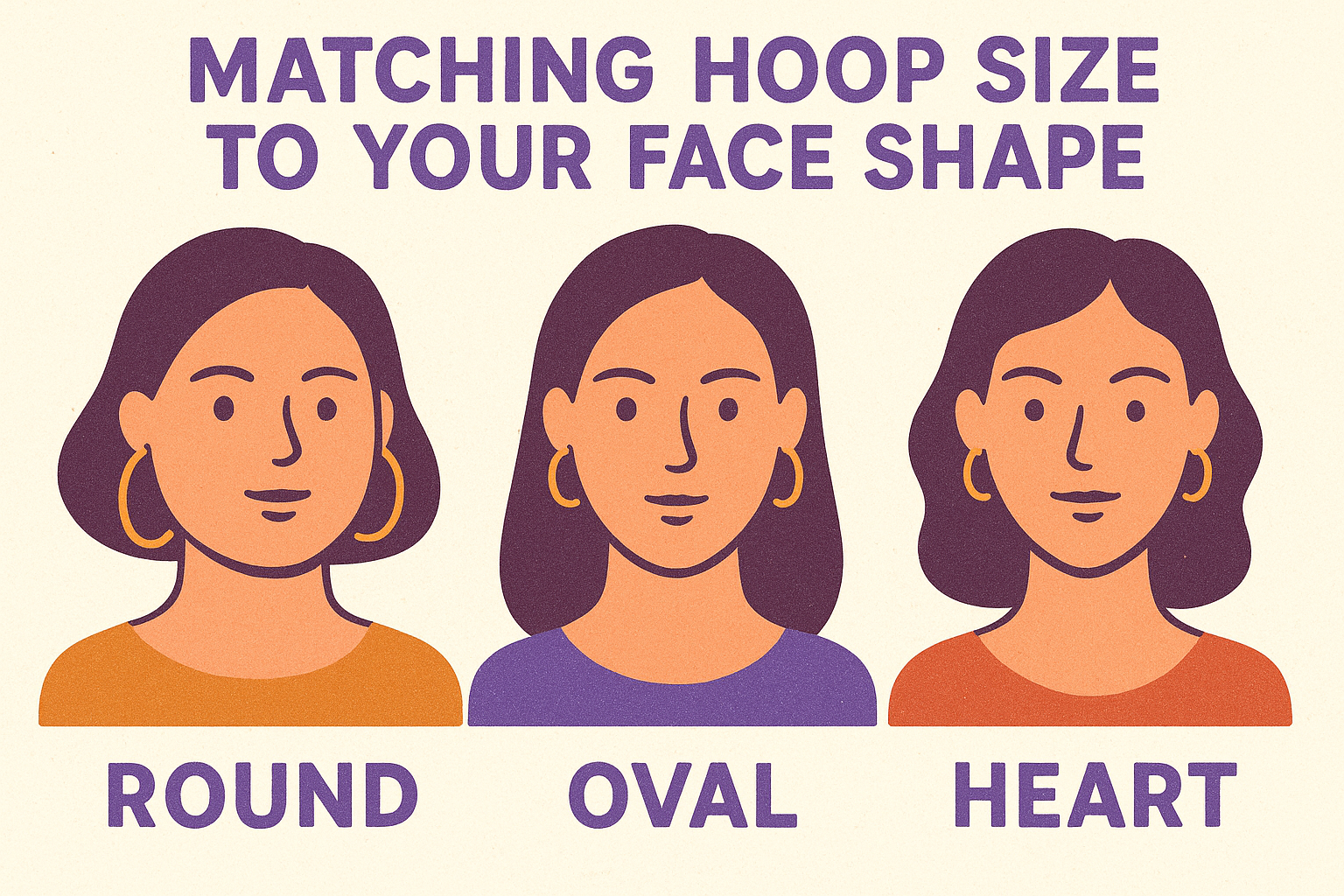
Your face shape is a useful starting point, not a hard restriction, so always factor in what actually makes you feel confident.
If you're unsure about your face shape, take a photo straight-on in natural light and trace the outer edges mentally. The outline will usually fall clearly into one of the standard categories, giving you a reliable reference point before you start comparing diameters.
Factoring in your daily routine
Active lifestyles call for smaller, more secure hoops with snap or seamless closures that won't catch on hair, scarves, or collars during movement. If you spend most of your day at a desk or in lower-intensity settings, a larger or more decorative hoop creates visual impact without any physical trade-off. Huggie hoops are the strongest everyday option for people who move frequently, since they sit flush against the lobe and have almost no surface area to snag on anything.
Consider also how often you want to switch your earrings throughout the week. If you prefer to put on a pair and leave them in for several days at a stretch, seamless hoops in a skin-safe material like titanium or surgical steel are the most practical choice. If you enjoy changing your look daily, a snap-closure hoop in a versatile medium size gives you the easiest on-and-off experience without sacrificing security or comfort over a long day of wear.
How to style hoop earrings for different occasions
Part of what makes understanding what are hoop earrings so useful is seeing how the same category of jewelry can shift to fit entirely different settings. The key is matching hoop size, finish, and weight to the environment you're dressing for, rather than defaulting to the same pair for every situation.
Everyday and casual settings
For low-key days, small to medium hoops in a polished gold or brushed finish do the most work with the least effort. A 20mm to 30mm round hoop pairs cleanly with jeans, a plain shirt, or a casual dress without looking like you tried too hard. If you wear your hair down, keep the diameter on the smaller side so the earring stays visible rather than disappearing behind your hair.
Thin gold hoops in the 25mm range are the single most versatile everyday earring you can own, because they work with virtually any casual outfit without adjustment.
Layering also works well in casual contexts. Stack a pair of huggie hoops in your second piercing alongside a medium hoop in your first hole to add depth to your look without introducing extra accessories that compete for attention.
Work and professional environments
Professional settings call for restraint in size but still allow for shape and texture. A medium hoop in the 25mm to 35mm range reads as polished and intentional without distracting from the rest of your appearance. Twisted or rope-textured hoops work especially well here because the surface detail adds visual interest without requiring extra size or dangling elements that might feel out of place in a more formal workplace.
Keep your other jewelry minimal when you wear hoops to work. A simple chain necklace or a single ring lets the earrings stand as a clear focal point without making your overall look feel overdone.
Evening and special occasions
Evenings and events are where larger, bolder hoops earn their place. A 45mm to 60mm hoop in a high-polish gold finish or with subtle stone detailing creates immediate visual impact that reads well in low lighting and photographs clearly. Pair oversized hoops with an updo or sleek pulled-back hair so the earring gets full visibility rather than competing with volume around your face.
For formal events, geometric or textured statement hoops work better than heavily embellished drop earrings because they provide drama while keeping the silhouette clean. The hoop shape itself does enough structural work that additional ornamentation rarely adds anything meaningful.
Quick recap
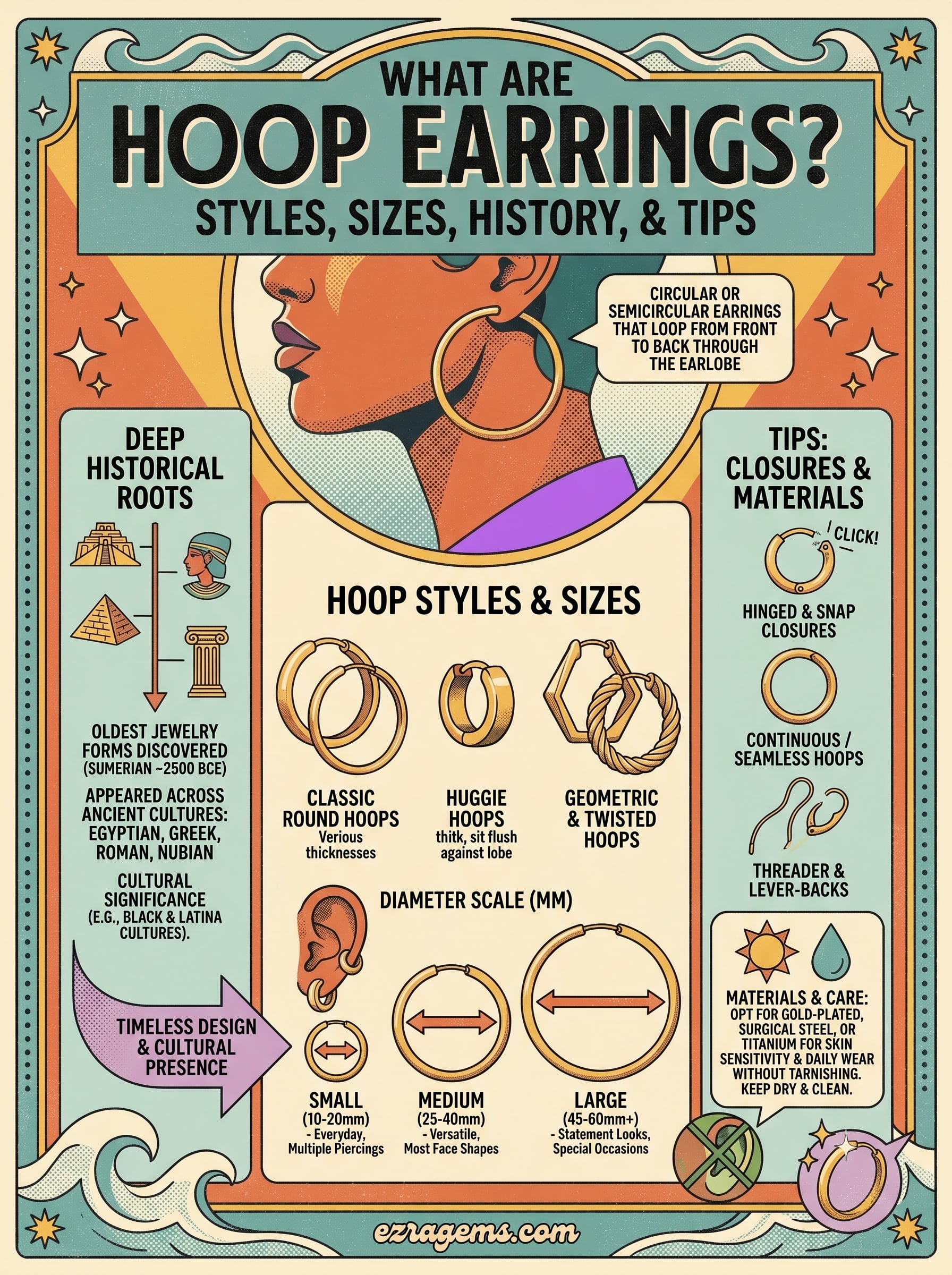
Now you know what are hoop earrings and everything that comes with that basic structure. Hoops thread through the ear, span a history stretching thousands of years, and range from subtle 10mm huggies to bold 60mm statement rings. The right pair depends on your face shape, your lifestyle, and the occasion you're dressing for, not any single rule that applies to everyone.
Material and closure type matter just as much as size. Nickel-free plating keeps your ears comfortable through long days of wear, and a secure snap or seamless closure makes hoops practical enough for daily use, not just special occasions. Whether you keep things minimal or stack multiple styles across your piercings, hoops offer more flexibility than almost any other earring category.
Ready to find your next pair? Browse the earrings at Ezra Gems and explore gold-plated hoops designed for everyday wear that won't tarnish or irritate your skin.
Leave a comment