


Freshwater pearls are a type of cultured pearl, not a separate category. “Freshwater” describes the mollusk’s environment (a river or lake), while “cultured” describes the human-assisted growing method used on nearly every commercially sold pearl today, as GIA explains. The comparison that actually affects what you buy is freshwater cultured versus saltwater cultured.
TL;DR:
- Selecting freshwater pearls over saltwater is advisable for durability and value, especially since they often have thicker nacre suitable for daily wear.
- High-grade freshwater pearls can now rival saltwater varieties in luster and shape, with solid nacre that resists wear better over time.
- Be cautious of vague origin claims and ensure sellers specify nacre thickness and nucleation method to verify quality and authenticity.
- Regular upkeep like gentle cleaning and proper storage can extend the lifespan of both freshwater and saltwater pearls, though solid-nacre freshwater pearls tolerate minor surface wear better.
- Most cultured pearls are treated for consistent color and shine, so buyers should ask about any enhancements to avoid surprises and assess value accurately.
Table of Contents
- Freshwater vs Cultured Pearls: Nacre, Luster, and Price
- How Do You Choose Between Freshwater and Saltwater Cultured Pearls?
- How Long Do Freshwater and Cultured Pearls Last?
- Why Ezra Gems Focuses on Freshwater Cultured Pearls
- Is Pearl Farming Environmentally Responsible?
- Are Pearls Treated or Enhanced Before Sale?
- Freshwater vs Cultured Pearls: What Buyers Need to Know
- Freshwater Pearl Picks Built for Everyday Wear
- Sources
Freshwater vs Cultured Pearls: Nacre, Luster, and Price
The category error trips up a lot of buyers, so it’s worth saying plainly: you’re never actually choosing between “freshwater” and “cultured.” You’re choosing between two cultured pearl types grown in different water, by different mollusks, using different nucleation methods. That distinction, not the freshwater label, drives nearly every difference in quality and cost.
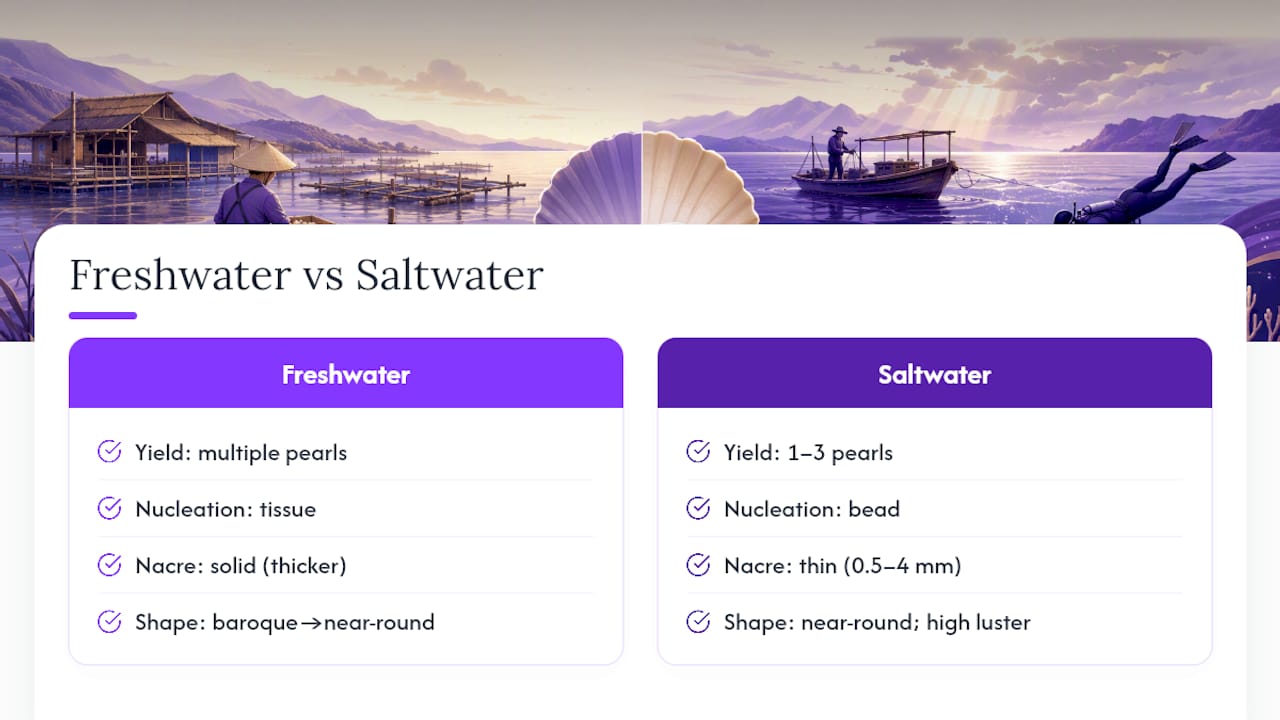
Nacre and nucleation. Most freshwater pearls come from tissue nucleation: farmers insert a small piece of mantle tissue into a mussel, and the pearl grows as solid nacre from the inside out. Saltwater pearls like Akoya use bead nucleation, where a round shell bead sits at the center and the mollusk deposits a comparatively thin nacre layer around it.
Nacre thickness by type: traditional tissue-nucleated freshwater pearls are solid nacre throughout. Bead-nucleated freshwater “AK” pearls run about 0.5 to 2 millimeters over the nucleus. Freshwater Edison pearls can reach 3 to 10 millimeters or more. Akoya pearls typically measure 0.5 to 0.8 millimeters, and South Sea pearls fall between 2 and 4 millimeters, according to trade nacre data compiled by Pearldecoded.
That gap matters because nacre is what gives a pearl its glow and its resistance to wear. A solid-nacre freshwater pearl has nowhere to “run out.” A thin-nacre bead-nucleated pearl can wear through at the drill hole after years of friction against a clasp or another bead.
Luster and shape. Akoya and South Sea pearls tend toward a sharp, mirror-like luster that freshwater pearls historically couldn’t match. That gap has narrowed. High-grade freshwater Edison and bead-nucleated AK pearls now reach near-round shapes with mirror luster that competes visually with saltwater varieties, sometimes at a fraction of the price. Traditional low-nucleated freshwater pearls still lean toward baroque and off-round shapes, which is part of their charm, not a defect.
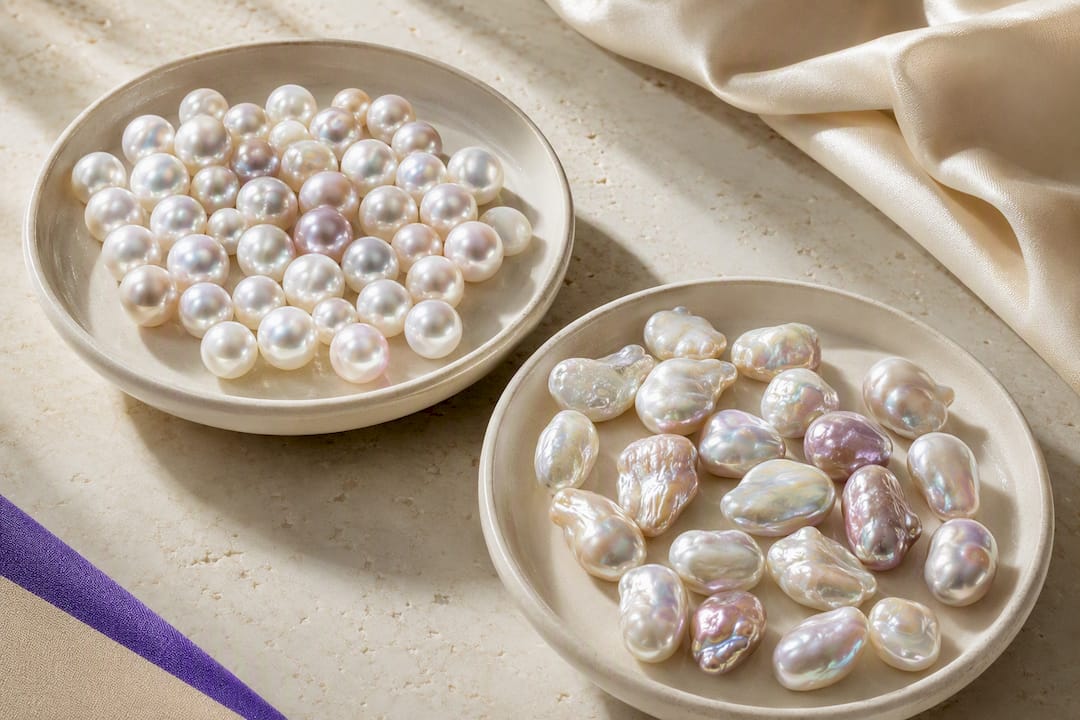
Durability in daily wear. Solid-nacre freshwater strands generally hold up better under regular use than thinly nacred bead-nucleated pearls, based on trade reports of Akoya nacre wearing thin at drill holes over time. If a piece is going on your wrist or around your neck every day, nacre depth is the number that should worry you more than the country of origin.
Supply and price. A freshwater mussel can produce multiple pearls in a single harvest. A saltwater oyster typically yields only 1 to 3 pearls per cycle. That yield gap is the single biggest reason freshwater pearls cost less: farmers get far more product per animal, per farming cycle. Geography compounds it. China produces the large majority of the world’s freshwater cultured pearls, while saltwater varieties come from Japan, Australia, and French Polynesia, where farming carries more environmental risk and variability. Add brand markup and distribution costs on top, and a saltwater strand can cost five to ten times its freshwater counterpart even when the visual quality is close.
How Do You Choose Between Freshwater and Saltwater Cultured Pearls?
Start with how you’ll wear the piece, not with the label on the tag. A strand for daily wear needs different priorities than a bridal heirloom or a one-time statement necklace.
- Decide the job first. Daily wear favors solid-nacre freshwater pearls for durability and value. Bridal or heirloom pieces often justify the higher, more uniform luster of Akoya or South Sea. A statement piece for occasional wear can lean baroque and freshwater without any real downside.
- Ask about nacre thickness. A reputable seller can tell you whether a pearl is tissue nucleated (solid nacre) or bead nucleated, and roughly how thick that nacre layer runs.
- Check surface and shape consistency. Look at close-up photos for chips, cracks, or heavy blemishing, and confirm the strand’s pearls match in size and shape rather than varying wildly.
- Confirm the return policy and any grading documentation. A seller unwilling to put grading or return terms in writing is telling you something.
Watch for a few specific red flags. Vague country-of-origin claims, a listing that calls a pearl “freshwater akoya” or “baby akoya,” and any absence of nacre information are all signs to slow down. GIA has specifically flagged “freshwater akoya” as a misleading label, since true Akoya pearls come only from the saltwater species Pinctada fucata. A freshwater pearl marketed with a saltwater name is borrowing credibility it hasn’t earned.
Pro Tip: Ask the seller directly, “Is this tissue nucleated or bead nucleated, and what’s the approximate nacre thickness?” A knowledgeable seller answers without hesitation. One who dodges the question probably doesn’t know, which tells you something about how the pearls were sourced.
If you’re shopping for necklace styles and want to see price ranges across designs first, a freshwater pearl necklace buying guide can help you calibrate expectations before you start comparing individual listings.
How Long Do Freshwater and Cultured Pearls Last?
With basic care, either type can last for decades, but the maintenance routine and the realistic lifespan differ slightly.
- Wipe pearls with a soft, dry cloth after each wear to remove skin oils and cosmetics before they build up.
- Store pearls flat or in a soft pouch, never tossed in a jewelry box where harder stones can scratch the nacre.
- Avoid perfume, hairspray, and lotion contact, since chemicals can dull luster over time on any pearl type.
- Restring necklaces every one to two years if worn frequently, since the silk thread wears out faster than the pearls do.
Because solid-nacre freshwater pearls have no bead core to expose, minor surface wear is easier to polish out without compromising the pearl’s structure. Thin-nacre bead-nucleated pearls have less margin for error. If a pearl in a saltwater strand starts showing a dull spot near the drill hole, that’s often the bead showing through, not something a jeweler can buff away.
Necklaces see more flexing and friction than studs or button earrings, so they need restringing attention that earrings and simple pendants don’t. If you notice unusual discoloration, a rough patch, or a pearl that feels lighter or hollow, that’s the point to get a professional gemological opinion rather than guessing. For step-by-step cleaning instructions, see this guide to cleaning pearl jewelry at home.
Why Ezra Gems Focuses on Freshwater Cultured Pearls
Every recommendation in this guide, nacre thickness, surface grading, realistic care expectations, comes from the same buyer checklist Ezra Gems applies when sourcing its own pieces. Freshwater cultured pearls hit a rare combination: solid nacre that holds up to daily wear, warm natural luster, and a price point that doesn’t require treating jewelry like a museum piece.
That’s the practical logic behind pairing genuine freshwater pearls with waterproof, hypoallergenic settings. A pearl that can survive a shower or a humid commute is only useful if the metal around it holds up too. Customer feedback across reviews consistently points to pieces that get worn constantly rather than saved for special occasions, which is exactly the use case solid-nacre freshwater pearls are built for.
Is Pearl Farming Environmentally Responsible?
Pearl farming, done well, is often described as a relatively low-impact form of aquaculture. Mollusks are filter feeders, and healthy pearl farms generally require clean water to function at all, since polluted water kills the animals farmers depend on. That creates a built-in incentive for farms to protect the waterways they operate in, though the reality varies widely by region and operator.
Freshwater pearl farming in China has faced periodic scrutiny over water use and farm density in some growing regions, while saltwater farming in places like French Polynesia and Australia tends to operate under tighter environmental permitting due to the sensitivity of ocean ecosystems and coral-adjacent farming sites.
Ethical sourcing questions extend beyond water quality. Labor conditions, farm transparency, and traceability all vary between operations and are difficult for an individual buyer to verify from a product listing alone. The most useful thing a buyer can do is ask sellers directly where their pearls are farmed and whether they can name the specific region or farm, not just the country. A seller who can answer specifically is usually sourcing more carefully than one who can’t.
Are Pearls Treated or Enhanced Before Sale?
Almost every cultured pearl on the market has undergone some form of enhancement, and that’s standard industry practice rather than a red flag on its own. Bleaching is common on freshwater pearls to even out natural color variations and improve overall consistency across a strand. Dyeing produces the vivid colors, deep black, bold pink, peacock green, that don’t occur naturally in most freshwater varieties. Luster enhancement through polishing is routine on both freshwater and saltwater pearls to bring out shine before pearls reach jewelry settings.
More invasive treatments exist too. Irradiation can darken pearls artificially, and coating treatments sometimes mask surface flaws or add artificial shine that doesn’t hold up over time. These matter more than color or bleaching because coatings can wear off unevenly, leaving a pearl looking patchy after a year or two.
None of this means treated pearls are lower quality. It means buyers deserve to know what they’re paying for. A seller should be able to tell you whether a pearl’s color is natural or dyed, and whether any surface coating was applied beyond standard polishing. If they can’t answer, that’s worth factoring into your decision the same way a vague origin claim is.
Freshwater vs Cultured Pearls: What Buyers Need to Know
The real lesson here isn’t about pearls at all. It’s about how easily a marketing framing can outlive its usefulness. “Freshwater vs cultured” got repeated so often across jewelry sites that it calcified into a comparison that doesn’t actually exist. Once you understand that freshwater pearls are cultured pearls, the whole buying process gets simpler, not more complicated.
Conventional advice tells buyers to chase saltwater names because they sound more prestigious. That advice undersells what modern freshwater farming can do. A well-graded freshwater Edison pearl with thick solid nacre will outlast and often outshine a thin-nacre bead-nucleated pearl wearing a fancier name.
My honest priority order for buyers: nacre thickness first, surface grade second, shape and size consistency third. Origin and species matter mostly because they help you verify the first three, not because one water source is inherently superior to another. Ask specific questions, and let the answers guide the price you’re willing to pay.
— Ezra
Freshwater Pearl Picks Built for Everyday Wear
Once you know what to look for, nacre depth, surface grade, honest labeling, the next step is finding pieces that actually deliver on it without demanding you baby them. Jewelry brands build freshwater pearl pieces on waterproof, hypoallergenic settings, so the metal survives the shower and the commute just as well as the nacre does.
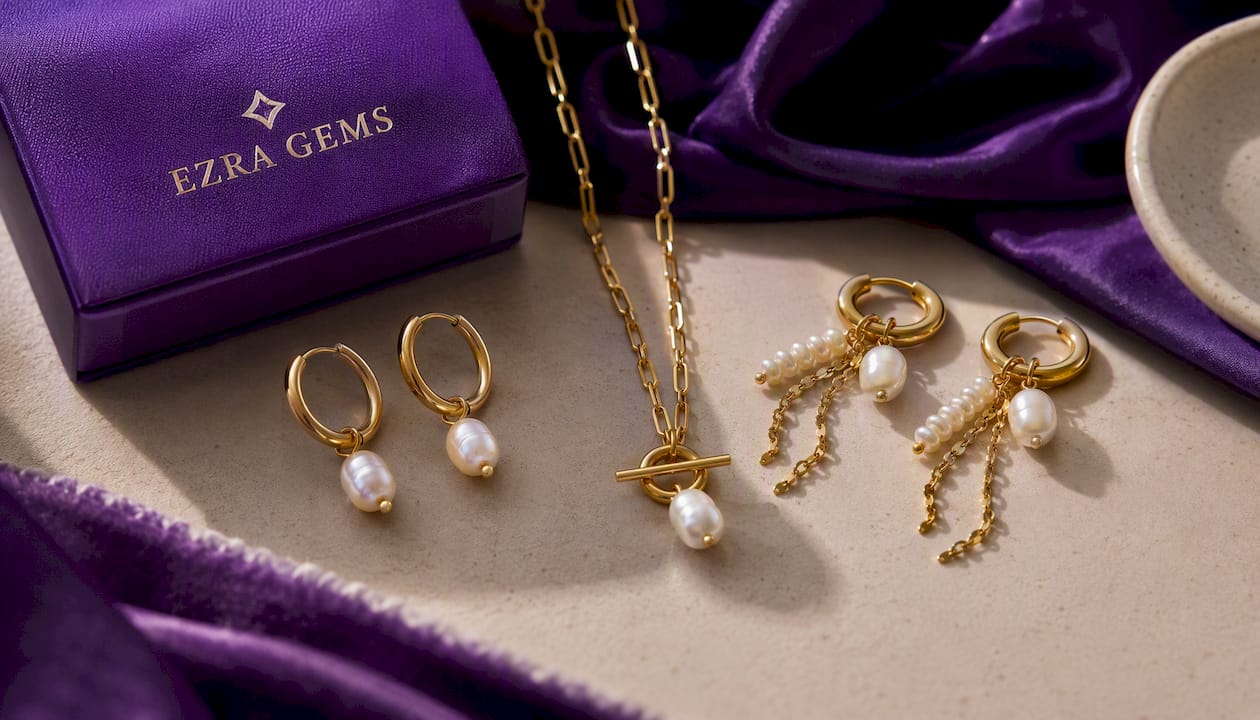
- Freshwater Pearl Hoop Earrings: a low-maintenance daily staple that pairs solid-nacre pearls with a hoop shape that works from gym bag to dinner reservation.
- Baroque Freshwater Pearl Pendant Necklace: the irregular baroque shape turns what used to be considered a lesser grade into the whole appeal, best for anyone buying a gift or a statement piece with personality.
- Freshwater Pearl Chain Tassel Earrings: a dressier option for readers who want pearls with movement, suited to evening wear without the fragility of a delicate bead-nucleated setting.
Check current availability and sizing on the product pages above, or browse the full freshwater collection to compare styles side by side before you buy.
Sources
- Pearl Description | GIA
- 7 Freshwater vs Saltwater Pearls Secrets: Avoid Overpaying & Choose Right | Pearldecoded
Laat een reactie achter