


If you've been shopping for gold jewelry that won't tarnish, fade, or turn your skin green, you've probably come across the term PVD coating on jewelry. It sounds technical, and it is, but understanding it can save you from wasting money on pieces that look great for a week and dull out by month two.
PVD, or Physical Vapor Deposition, is one of the most durable coating methods available for fashion jewelry today. It's the reason some gold-plated pieces hold up through showers, workouts, and daily wear while others don't survive a single hand wash. At Ezra Gems, we care about this distinction because our customers expect jewelry that actually lasts, not jewelry that requires a display case to stay pretty.
This guide breaks down exactly how PVD coating works, how it compares to traditional gold plating and solid gold, what affects its longevity, and how to care for PVD-coated pieces so they stay looking sharp. Whether you're evaluating your next jewelry purchase or just curious about what makes certain pieces more resilient, you'll walk away with a clear, practical understanding of PVD coating and its real-world value.
Why PVD coating matters for jewelry buyers
When you're spending money on jewelry, durability and appearance over time are two things that should factor into your decision from the start. Most fashion jewelry uses standard electroplating, which deposits a thin layer of gold onto a base metal. That layer wears off, and when it does, you're left with discoloration, tarnishing, and in some cases, skin reactions from the exposed base metal underneath. Understanding what is pvd coating on jewelry gives you a concrete way to avoid that outcome.
The problem with standard plating
Standard gold electroplating puts down a layer that's typically 0.5 to 2.5 microns thick. That sounds small because it is. Daily wear, sweat, lotion, and friction all eat away at that layer faster than most buyers expect. Many electroplated pieces start showing visible wear within a few months, especially with consistent use. The coating chips or fades unevenly, and the jewelry ends up looking worse than it would have if you'd skipped the gold finish entirely.
The thinner the coating, the faster you'll see the base metal underneath, and once that happens, the piece is essentially done.
What PVD coating delivers that standard plating doesn't
PVD coating bonds at a molecular level to the surface of the jewelry, creating a finish that's significantly harder and more adhesive than electroplating. The result is a layer that resists scratching, fading, and oxidation far better than traditional methods. When you wear PVD-coated jewelry through a workout, a swim, or a long day outdoors, the finish holds its color and integrity in conditions that would visibly degrade standard plating.
This matters beyond just aesthetics. Skin-safe wearability is a real concern for people who react to base metals like brass or copper when plating wears thin. Because PVD coating is more durable and adheres more tightly, the base metal stays protected longer. You get a piece that's genuinely safer and more comfortable for daily, all-day wear.
Why value comes down to longevity
A piece that costs $40 and lasts two years gives you far better value than a $20 piece you replace every three months. PVD-coated jewelry sits firmly in the first category when cared for properly. The upfront cost may be slightly higher than the cheapest fashion jewelry options, but the cost-per-wear calculation shifts dramatically in your favor over time.
For buyers who wear jewelry every single day, that distinction is significant. PVD coating is one of the few finishing technologies that genuinely closes the gap between fashion jewelry and fine jewelry durability at a price point that doesn't require a major investment. You're not just buying a look; you're buying how long that look stays intact.
How PVD coating works on jewelry
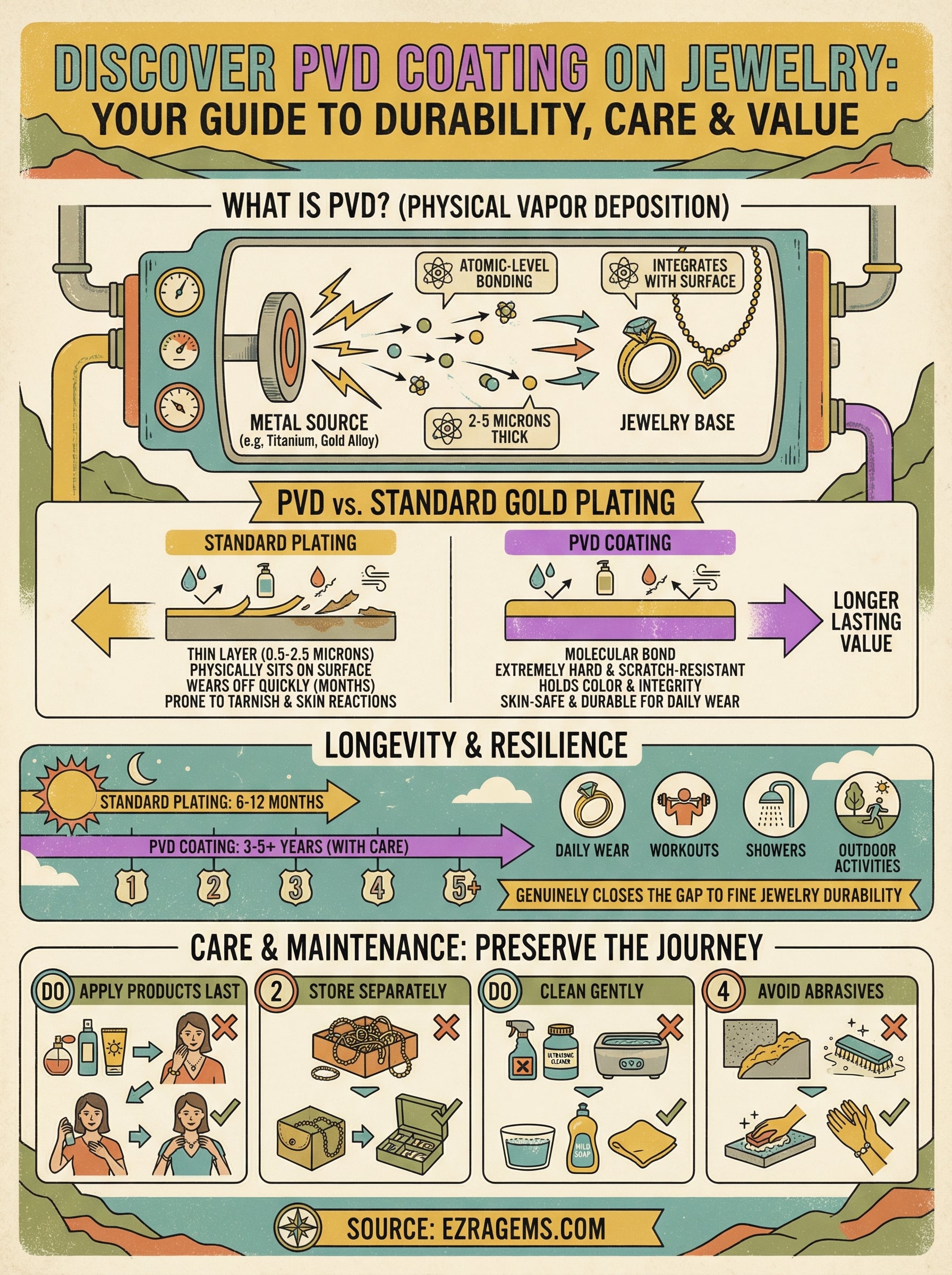
The process behind what is pvd coating on jewelry is more sophisticated than standard plating, and that sophistication is exactly why the results hold up better. PVD stands for Physical Vapor Deposition, and it describes a vacuum-based process that vaporizes a solid metal source and deposits it directly onto the jewelry surface at the atomic level.
The vacuum chamber process
To apply a PVD coating, the jewelry gets placed inside a sealed vacuum chamber. The chamber removes nearly all air, creating an environment where metal can be vaporized without interference from oxygen or moisture. A target material, typically titanium nitride, zirconium, or a gold alloy, gets bombarded with high-energy ions that knock particles off the target and send them toward the jewelry piece. Those particles land and bond directly onto the surface.
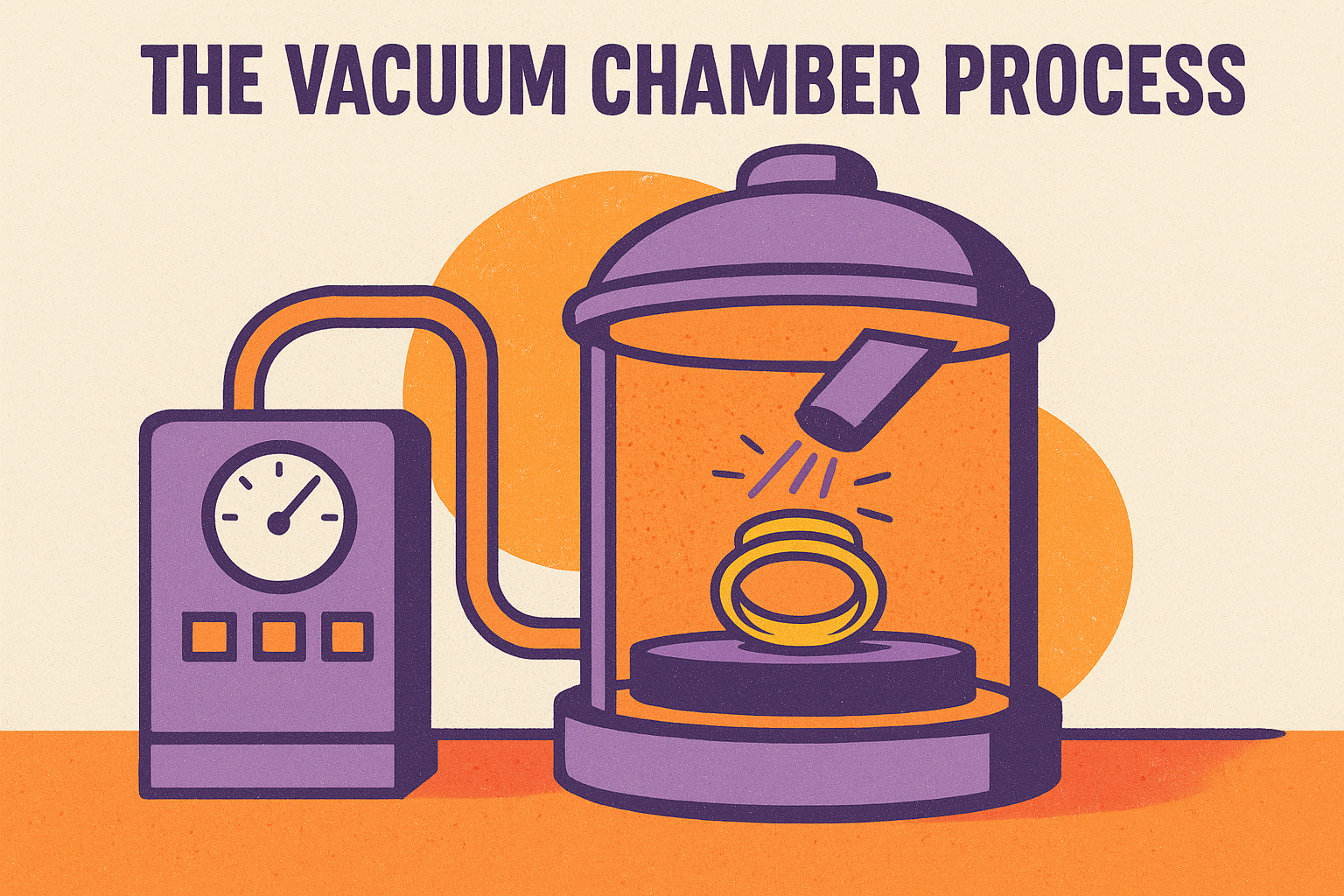
Because the bonding happens in a near-vacuum at the atomic level, the resulting layer is far more uniform and adhesive than anything produced in a standard liquid plating bath.
What gets deposited and why it sticks
The deposited layer in PVD coating is typically 2 to 5 microns thick, which is noticeably thicker and denser than standard electroplating. More importantly, the particles don't just sit on top of the surface; they penetrate and integrate with it at a molecular level, which is why PVD coatings resist peeling and chipping in ways that traditional plating simply can't match.
Your end result is a finish that is extremely hard, often harder than the base metal itself. That hardness translates directly into scratch resistance and color stability, allowing the coating to handle friction from clothing, accessories, and daily contact without breaking down. You get a piece that looks consistent from the first wear to the hundredth.
PVD vs gold plating and solid gold
Understanding what is pvd coating on jewelry becomes clearer when you place it directly next to the alternatives. The three main options you'll encounter are standard gold electroplating, PVD coating, and solid gold, and each one offers a different tradeoff between cost, durability, and how the piece holds up over time with real wear.
How PVD compares to standard gold plating
Standard gold plating and PVD coating both apply a gold-toned finish to a base metal, but the similarity ends at appearance. Electroplating uses an electrical current in a liquid bath to deposit metal ions onto the surface, producing a layer that physically sits on top of the piece rather than bonding into it. That layer is typically 0.5 to 2.5 microns thick and wears away with friction, sweat, and exposure to water or chemicals.
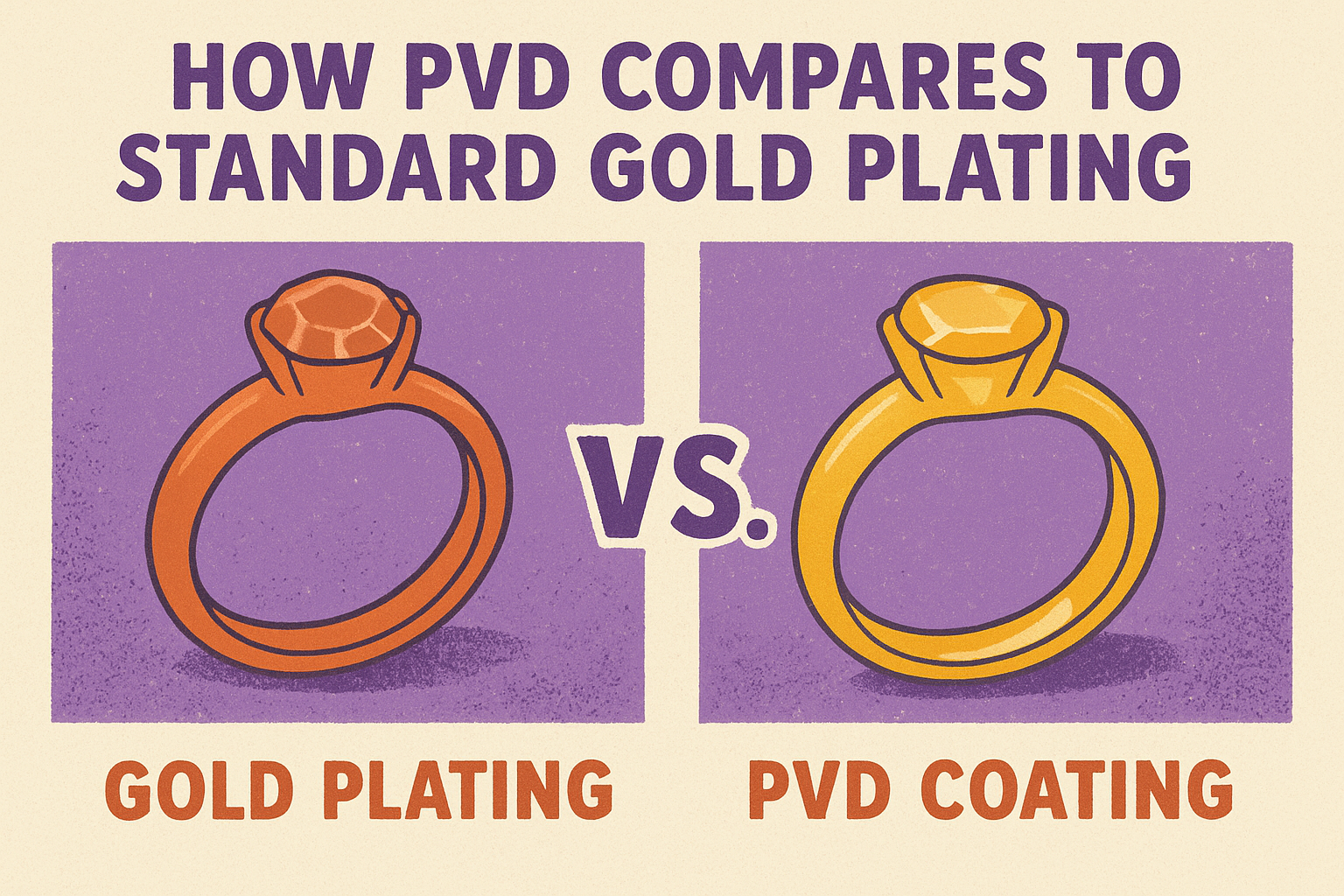
PVD coating bonds at the atomic level inside a vacuum chamber and produces a layer that's 2 to 5 microns thick with far superior adhesion. You get a finish that's harder, more scratch-resistant, and substantially more resistant to the conditions that destroy standard plating within months of daily wear.
If you wear your jewelry every day, the difference between PVD and standard plating becomes visible within months, not years.
How PVD compares to solid gold
Solid gold is the benchmark for longevity and intrinsic value, but it comes with a price tag that puts it out of reach for most everyday jewelry purchases. A solid 14k or 18k gold piece will last indefinitely with basic care, but you'll pay significantly more upfront, and the cost scales with every additional piece you want to own.
PVD-coated jewelry closes much of that durability gap at a fraction of the price. You won't get the same metal value, but you will get a piece that holds its finish through daily wear without requiring fine jewelry maintenance or fine jewelry spending. For most buyers, that tradeoff is the practical choice.
How long PVD jewelry lasts and what affects it
One of the most common questions from people researching what is pvd coating on jewelry is how many years they can realistically expect the finish to hold. Under normal daily wear, a well-made PVD-coated piece typically lasts 3 to 5 years before showing any noticeable degradation, and many pieces last significantly longer with basic care. That's a meaningful improvement over standard plating, which often shows visible wear within 6 to 12 months under the same conditions.
Typical lifespan you can expect
The 3-to-5-year range assumes consistent everyday wear, meaning you put the piece on in the morning and take it off at night. Pieces worn occasionally will last much longer simply because they accumulate less friction and chemical exposure over time. High-contact jewelry like rings and bracelets tends to show wear earlier than necklaces or earrings, because those pieces make direct contact with surfaces, fabrics, and skin throughout the day.
The more contact a piece makes with external surfaces, the faster any coating, including PVD, will show signs of use.
Factors that shorten PVD coating
Several specific behaviors and exposures will reduce the lifespan of your PVD finish faster than ordinary wear would. Knowing these upfront helps you make small adjustments that add real time to your jewelry's appearance.
- Chemical exposure: Chlorine, bleach, and household cleaning products break down the coating surface over repeated contact.
- Abrasive contact: Scrubbing the piece or storing it loosely with other jewelry creates micro-scratches that dull the finish gradually.
- Perfume and lotion buildup: These products leave residue that weakens the outer layer when applied directly to the jewelry.
- High-friction activities: Constant rubbing against rough fabrics or hard surfaces accelerates surface wear on any coated piece.
Avoiding these conditions doesn't require major changes to how you live. It mostly comes down to putting your jewelry on last when you're getting ready and taking it off first before using cleaning products or swimming in a chlorinated pool.
How to care for PVD-coated jewelry
Caring for PVD-coated jewelry is straightforward once you understand what the finish responds well to and what shortens its life. The coating is significantly more resilient than standard plating, but it's not immune to neglect. A few consistent habits will keep your pieces looking sharp for years instead of months, and none of them require specialized products or complicated routines.
Daily habits that protect the finish
The single most effective thing you can do is apply products before putting on your jewelry, not after. Perfume, lotion, sunscreen, and hairspray all leave chemical residue that breaks down the coating surface with repeated contact. Put your jewelry on as the last step of getting ready and take it off before applying anything to your skin or hair.
Putting jewelry on last and taking it off first costs you nothing and adds real time to how long your pieces hold their finish.
Storage also matters more than most people realize. Tossing PVD-coated pieces into a drawer or jewelry box with other items creates constant micro-abrasion that dulls the surface over time. Store each piece separately in a pouch or a lined compartment to prevent contact with harder metals or clasps.
Cleaning your PVD jewelry the right way
When your pieces need cleaning, keep it simple and gentle. Warm water and a small amount of mild dish soap applied with a soft cloth or a soft-bristle toothbrush is all you need. That combination removes skin oils, sweat, and product buildup without introducing anything abrasive or chemical that would damage the coating.
Avoid ultrasonic cleaners, harsh chemical cleaners, and abrasive polishing cloths entirely. These methods are designed for solid gold or harder materials and will strip or dull a PVD finish faster than everyday wear would. Once you understand what is pvd coating on jewelry and how the bonding works, it's clear that the coating needs gentle handling, not aggressive cleaning, to stay intact over the long term.
Key takeaways and next steps
Now that you understand what is pvd coating on jewelry, the choice between PVD, standard plating, and solid gold comes down to what you actually need from a piece. PVD coating gives you a finish that bonds at the molecular level, resists daily wear, and holds up through conditions that destroy standard electroplating within months. That makes it the practical choice for anyone who wears jewelry every day and wants it to look good a year from now, not just in the first week.
Your care habits matter too. Keep products off your jewelry until after you put it on, store pieces separately, and clean them gently with soap and water. Those three habits alone add real time to any PVD finish. If you're ready to invest in pieces built to last, browse the Ezra Gems bestsellers and find styles that actually hold up to your life.
Leave a comment