


You found a piece of jewelry at a thrift store, inherited something from a relative, or bought something online, and now you're not sure what it's actually made of. Knowing how to tell if jewelry is stainless steel matters more than you might think, because the metal determines everything from durability to how your skin reacts when you wear it daily.
Stainless steel is one of the most common metals used in affordable jewelry. It's tough, tarnish-resistant, and generally hypoallergenic, qualities we care about deeply at Ezra Gems, where our own collections are built around waterproof, tarnish-free pieces designed for everyday wear. But not every item labeled "stainless steel" actually is, and mislabeled metals can cause green skin, irritation, or rapid deterioration.
The good news? You don't need a jeweler or a lab to figure it out. This guide covers 7 straightforward tests you can do at home, from spotting hallmark stamps to grabbing a kitchen magnet, so you can verify what your jewelry is made of before it ever touches your skin.
Before you test: know grades and look-alikes
Before you run any test, it helps to understand what stainless steel actually is and which metals could easily fool you. Stainless steel is an alloy made primarily of iron, with at least 10.5% chromium added to form a protective oxide layer that resists rust and corrosion. Not all stainless steel is the same, and the grade matters significantly when it comes to jewelry.
The two grades you'll see most in jewelry
Jewelry makers typically use one of two grades: 304 stainless steel (also called 18/8 because it contains 18% chromium and 8% nickel) or 316L stainless steel (marine grade, with added molybdenum for extra corrosion resistance and a lower carbon content). For everyday jewelry, 316L is the better choice because it [handles sweat, chlorine, and saltwater](https://ezragems.com/blogs/blog-posts-by-ezra-gems/how-to-clean-stainless-steel-jewelry) without degrading and is far less likely to irritate sensitive skin. If a seller doesn't specify the grade, that alone is worth paying attention to.
When shopping for stainless steel jewelry, look specifically for 316L grade. It performs significantly better against daily exposure than lower-grade alternatives.
Metals that can look identical to stainless steel
Several metals share stainless steel's cool, silver-toned finish, which makes relying on appearance alone unreliable. Aluminum carries a similar shine but is noticeably lighter and scratches far more easily. Titanium looks nearly the same but feels almost weightless by comparison and is non-magnetic. Chrome-plated brass or zinc passes as stainless steel until the outer layer wears through and a yellowish base metal appears underneath.
Sterling silver is another common look-alike. It carries a "925" hallmark stamp and tarnishes over time to a darker, grayish tone, while stainless steel holds its color. Nickel-plated jewelry is the most problematic of these look-alikes because nickel closely mimics stainless steel's finish but can trigger contact dermatitis in a large portion of the population.
Getting clear on these distinctions is the starting point for knowing how to tell if jewelry is stainless steel with any confidence. The tests covered in the next steps rely on physical properties and observable behaviors, not just visual guesswork, so you can move through them systematically and arrive at a reliable answer.
Step 1. Check for stamps and construction clues
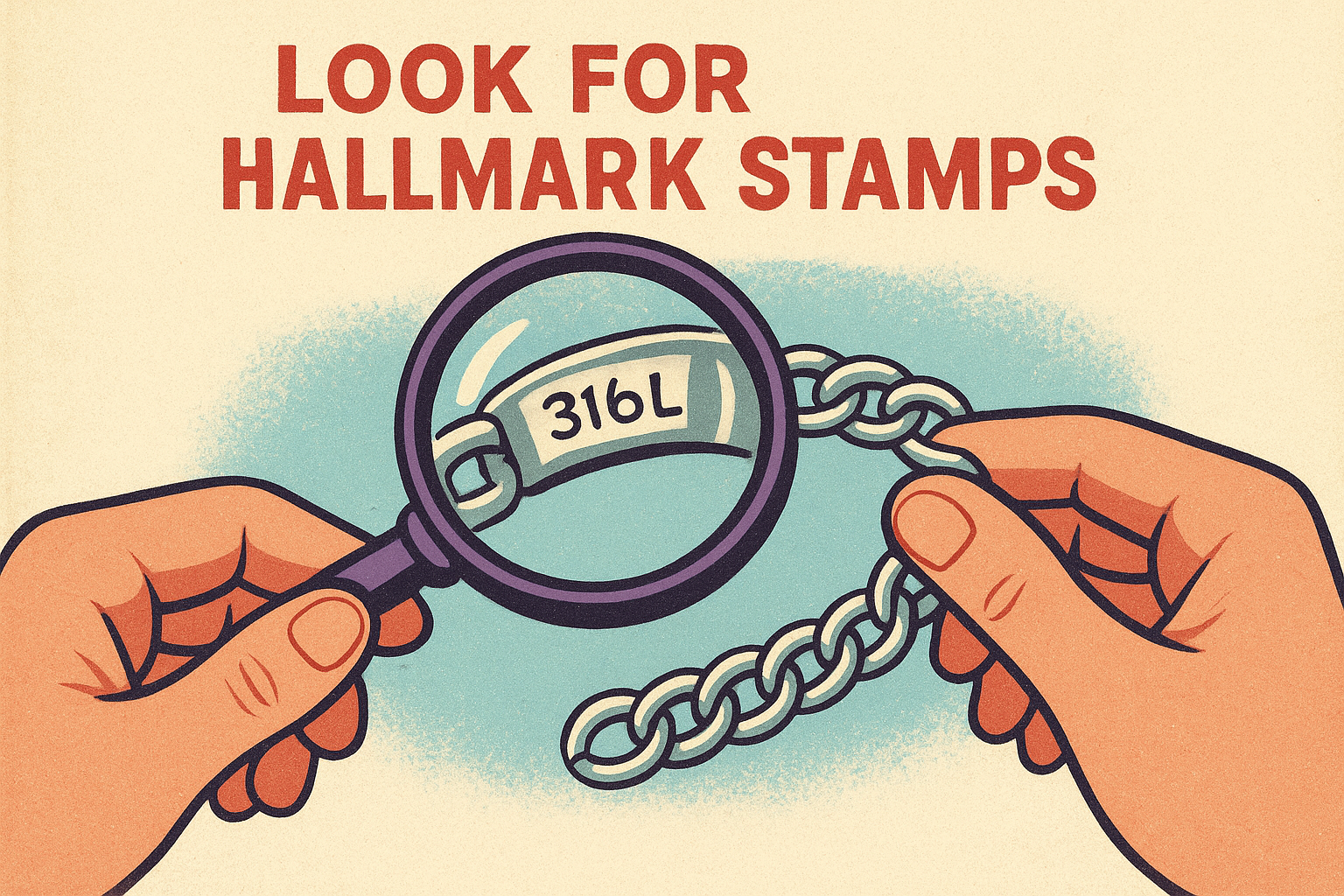
Your first move is to grab a magnifying glass and examine every surface of the piece before doing anything else. Hallmark stamps and build quality give you the clearest, fastest clues on how to tell if jewelry is stainless steel without any special tools or materials.
Look for hallmark stamps
Flip the piece over and look at the clasp, inner band, or back of a pendant. Genuine stainless steel jewelry is commonly stamped with one of the following identifiers:
| Stamp | What it means |
|---|---|
| 316L | Marine-grade stainless steel, best for jewelry |
| 304 | Standard-grade stainless steel |
| SS | General abbreviation for stainless steel |
| INOX | European term for stainless steel |
If you see "925," "800," or "PLAT," the piece is sterling silver or platinum, not stainless steel. No stamp at all is not automatically a red flag since some lower-cost pieces skip marking, but a clear 316L or SS stamp is strong confirmation.
A 316L stamp is your most reliable visual indicator that the piece is jewelry-grade stainless steel built to handle daily wear.
Check construction quality
Stainless steel pieces tend to feel solid and uniform in weight, without hollow sections that flex when you press them. Run your thumbnail along any edges. Well-finished stainless steel has smooth, consistent edges with no rough spots or uneven plating lines that suggest a base metal was coated over.
Clasps and hinges on stainless steel jewelry move cleanly without any creaking or soft give, since the metal holds its shape under pressure rather than bending like softer alloys.
Step 2. Do quick non-damaging tests
After checking stamps and construction, the next round of tests requires nothing more than a refrigerator magnet or a quick feel in your hand. These tests won't scratch or mark the piece, which makes them a good second step when figuring out how to tell if jewelry is stainless steel at home.
The magnet test
Hold a standard magnet close to the piece and note the response. Stainless steel has iron in its composition, which means it often shows a slight magnetic attraction, though the strength varies by grade. 304 stainless steel tends to attract a magnet more noticeably, while 316L in its annealed state may attract only weakly or not at all.
A weak or absent magnetic response doesn't rule out stainless steel, but a complete non-reaction combined with other clues points toward a different metal entirely.
Use this table to read what the magnet's behavior tells you:
| Magnetic response | Likely metal |
|---|---|
| Weak attraction | 316L or 304 stainless steel |
| Strong snap | Lower-grade steel or iron-heavy alloy |
| No attraction at all | Titanium, aluminum, or non-ferrous alloy |
The weight and temperature test
Pick up the piece and compare its heft against other known metals you have nearby. Stainless steel feels noticeably heavier than aluminum and most plastics, but lighter than solid brass or copper.
Set the piece down on a cool surface for a moment, then pick it up again. Genuine metal, including stainless steel, pulls heat from your fingers quickly, giving a noticeable cool-to-the-touch sensation almost immediately. Plastic or resin pieces coated to look metallic warm up far more slowly and feel lighter than they should for their size.
Step 3. Check for tarnish, rust, and wear
One of the most telling ways to understand how to tell if jewelry is stainless steel is to observe how a piece ages. Stainless steel holds its appearance over time because the chromium in the alloy forms a self-repairing protective layer. If you've worn the piece or left it in a drawer for a while, the condition of its surface tells you a great deal about what it's actually made of.
Surface signs: tarnish and rust
Genuine stainless steel does not tarnish in normal conditions, which means a dull, darkened surface is a clear sign you're dealing with a different metal. Sterling silver develops a dark gray or yellowish film, and lower-quality alloys with copper content turn greenish over time. Run a soft white cloth along the surface and check what transfers onto it. Any dark or greenish residue signals that the piece is not stainless steel.
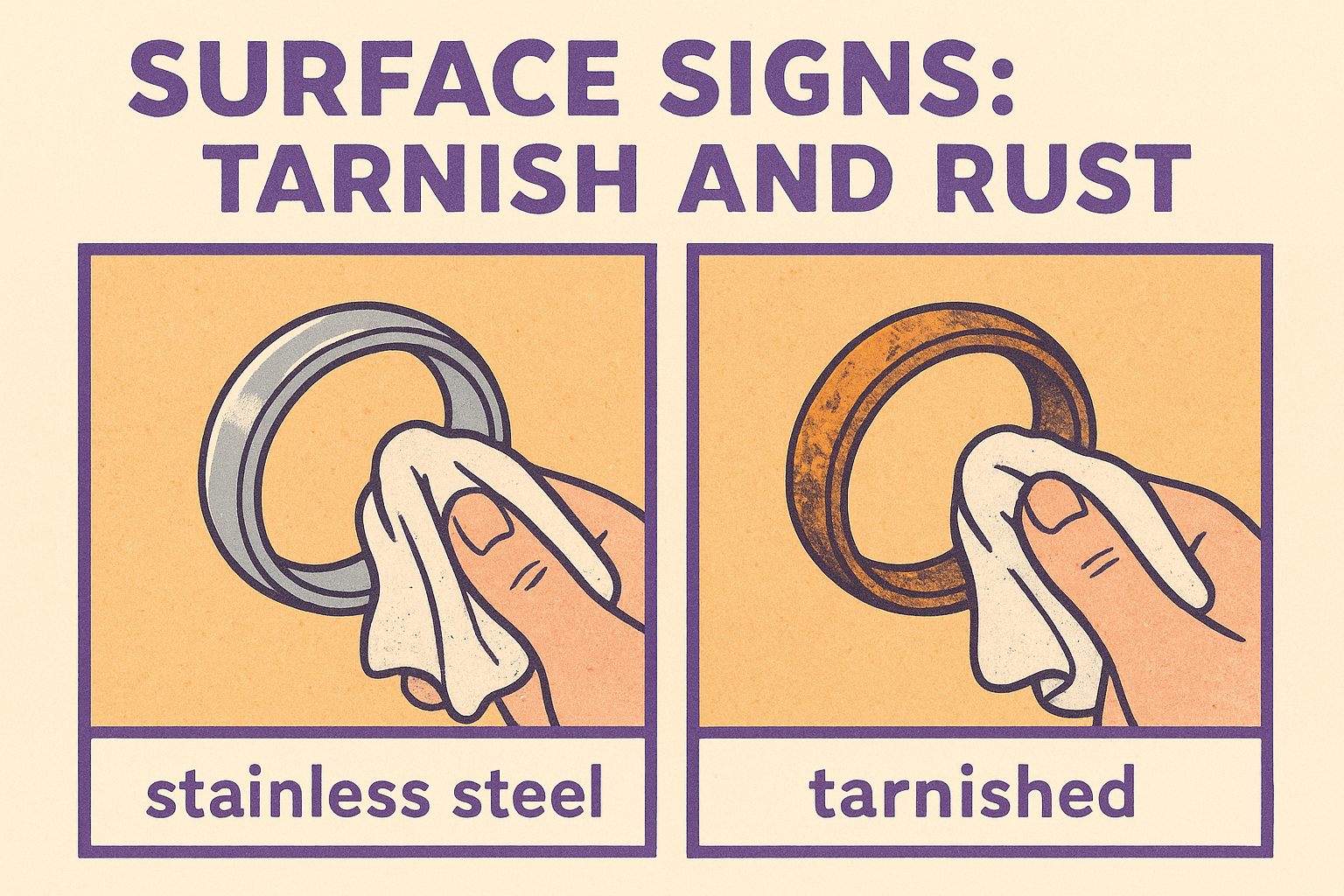
If you spot orange or reddish surface marks on a piece, that's rust, and stainless steel simply does not rust under normal everyday wear conditions.
What wear patterns reveal
Examine high-contact areas like the inner band of a ring or the clasp attachment on a necklace. Stainless steel maintains a consistent color all the way through, so worn spots look identical to the rest of the piece. If those areas show a yellowish, coppery, or brassy tone underneath, the item is plated over a base metal rather than solid stainless steel. Plating wears through at friction points first, so those spots give the base metal away quickly.
Step 4. Try last-resort tests safely
When stamps are absent and the earlier tests leave you uncertain, two physical tests can push you toward a clear answer. These methods carry a small risk of minor surface marks, so apply them only on inconspicuous areas and treat them as a last resort rather than a starting point for figuring out how to tell if jewelry is stainless steel.
The scratch test on unglazed ceramic
Press the piece firmly against the unglazed back of a ceramic tile and drag it across the surface. Look at the streak it leaves behind. Stainless steel leaves a gray or silver-toned mark consistent with its alloy composition. A yellowish or coppery streak tells you the base metal underneath is brass or copper, even if the surface looks silver. Aluminum leaves a dull white streak, and titanium produces a very faint gray line lighter than what stainless steel leaves.
Check the piece itself after the streak test, not just the tile. Stainless steel shows only light surface contact, while softer metals show visible scratching on the piece.
The acid spot test
This test uses a small amount of diluted nitric acid, which you can find at hardware stores or jewelry supply retailers. Apply a single drop to a hidden spot using a toothpick or cotton swab. Stainless steel shows little to no reaction because the chromium oxide layer resists acid. A greenish or brownish bubbling reaction indicates copper or brass content. Sterling silver turns creamy white, and iron-based alloys turn dark almost immediately. Rinse the piece thoroughly with water right after testing and neutralize with a small amount of baking soda dissolved in water.
What to do if you still feel unsure
Even after running through all seven tests, you might still land on a gray area. Some pieces use mixed construction, combining stainless steel components with base metal findings, which produces confusing results across tests. When the evidence points in multiple directions, your next move is to get outside verification rather than guessing.
Take it to a professional
A local jeweler can tell you exactly what a piece is made of using acid test kits, XRF analyzers, or spectrometry tools that identify the precise metal composition without damaging the piece. Most jewelers offer this as a quick in-store service, and many do it at no charge or for a small fee. Call ahead to confirm they test non-precious metals, since some shops focus only on gold and silver identification.
Knowing how to tell if jewelry is stainless steel through home tests is useful, but a professional XRF reading gives you a definitive answer in under a minute.
If you want a portable option, handheld XRF analyzers are available for purchase and give instant elemental breakdowns, though they carry a significant upfront cost that only makes sense if you test pieces regularly.
Ask the seller directly
Contact the seller and ask for the specific metal grade in writing, not just a general label like "stainless steel." Request documentation such as a material data sheet or a product specification from the manufacturer. Reputable sellers will provide this readily. If a seller refuses or can only confirm "metal alloy" without specifics, treat that as a strong signal to walk away. Your skin and your money are both worth protecting with a clear, documented answer.
A quick recap
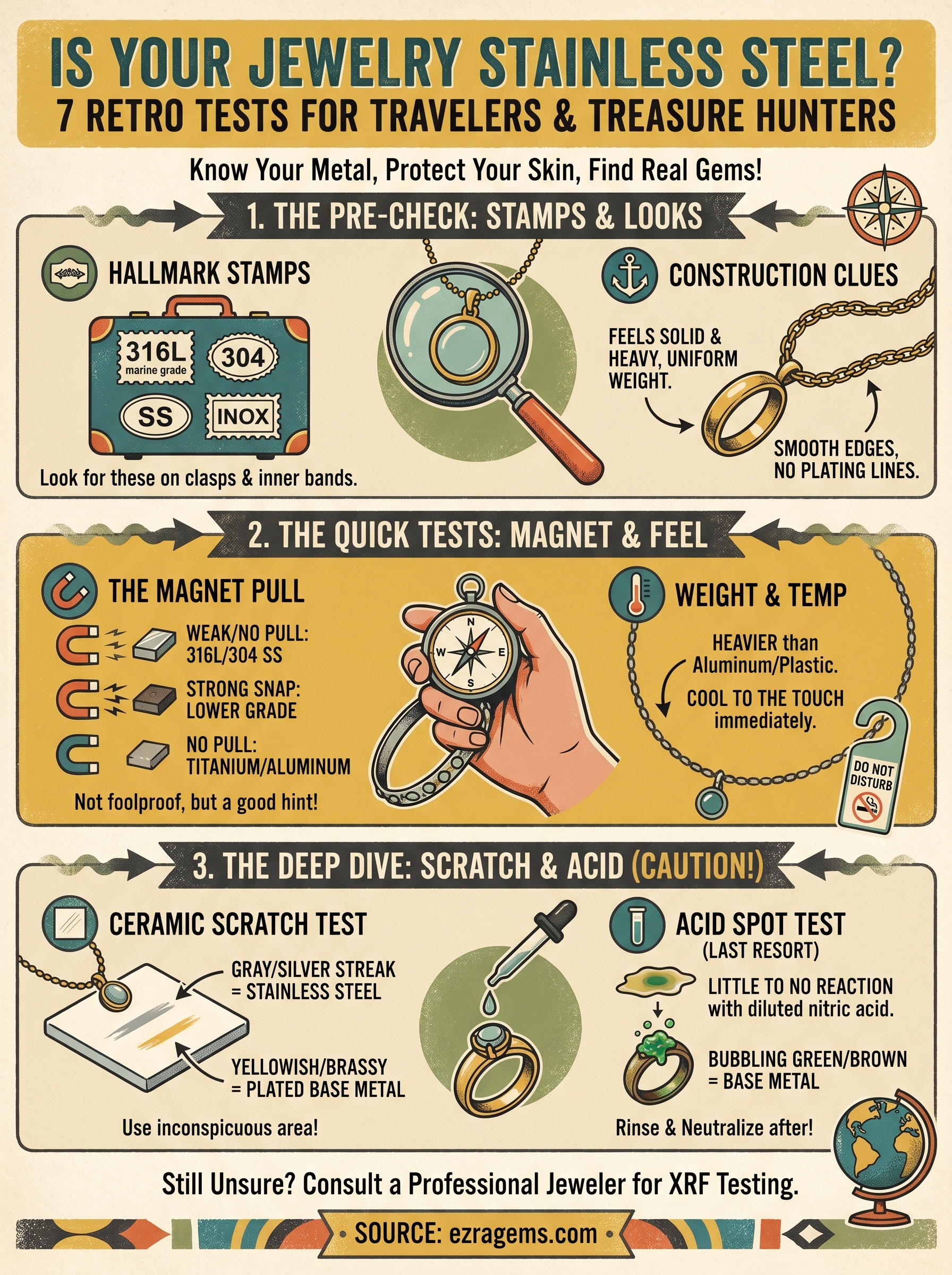
Seven tests give you a reliable system for how to tell if jewelry is stainless steel without sending anything to a lab. Start with hallmark stamps like 316L, SS, or INOX, then check construction quality. Run the magnet test and weigh the piece against metals you already know. Look for tarnish, rust, and wear patterns that expose the base metal underneath. If you still need confirmation, try the ceramic streak test or an acid spot test on a hidden area. When home tests leave you uncertain, a jeweler with an XRF analyzer gives you a definitive answer fast.
Knowing what your jewelry is made of protects both your skin and your money. If you want pieces where the answer is never in question, Ezra Gems builds every collection around verified, skin-safe materials designed to last through daily wear without tarnishing or irritating your skin. Browse our waterproof, hypoallergenic jewelry collections and shop with complete confidence.
Leave a comment